

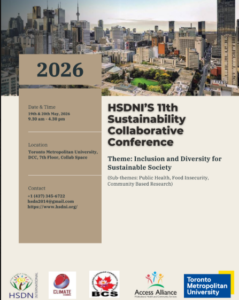
HSDNI’s 11th Sustainability Collaborative Conference: Inclusion and Diversity for a Sustainable Society
May 19, 2026 | Toronto Metropolitan University, Toronto, Canada
The Holistic Sustainable Development Network International (HSDNI) successfully brought together researchers, academics, community organizations, professionals, and sustainability advocates for its 11th Sustainability Collaborative Conference, held on May 19, 2026, at Toronto Metropolitan University (TMU), Toronto, Canada.
Under the theme “Inclusion and Diversity for a Sustainable Society,” the conference provided an interdisciplinary platform to explore the interconnected challenges of sustainability, social inclusion, public health, food insecurity, and community-based research.
The event reflected HSDNI’s ongoing commitment to promoting holistic sustainable development through collaboration, knowledge mobilization, and engagement with diverse communities.
Sustainability Through Inclusion and Diversity
Sustainable development requires more than economic growth and environmental protection. It also depends on social equity, cultural diversity, community participation, and the well-being of individuals and societies.
HSDNI recognizes that sustainability challenges are interconnected and cannot be addressed effectively through isolated approaches. Environmental protection, economic development, public health, and social justice must be considered together to create meaningful and lasting change.
The conference theme emphasized the importance of recognizing diverse experiences and perspectives in shaping sustainable societies.
By bringing together researchers, community stakeholders, and individuals with lived experiences, HSDNI sought to encourage dialogue on how inclusive approaches can strengthen social cohesion, address inequalities, and support sustainable development.
Exploring the Key Themes
The conference focused on three important sub-themes:
1. Public Health
Public health is a fundamental component of sustainable development. Healthy communities depend on equitable access to healthcare, safe environments, social support, and opportunities for well-being.
The conference encouraged discussion on the social and environmental determinants of health and the importance of inclusive public health approaches.
Participants were invited to consider how institutions, community organizations, and policymakers can collaborate to address health inequalities and improve the well-being of diverse populations.
Public health sustainability requires recognizing that health outcomes are influenced not only by individual choices but also by broader social, economic, environmental, and institutional conditions.
2. Food Insecurity
Food insecurity remains a significant challenge for communities across the world, including in Canada.
Access to sufficient, nutritious, culturally appropriate, and affordable food is essential for human health, dignity, and sustainable development.
The conference highlighted food insecurity as an issue connected to poverty, inequality, public health, environmental sustainability, and social inclusion.
Addressing food insecurity requires collaborative approaches that consider the experiences of marginalized communities and the structural conditions affecting access to food.
The discussions also reflected the importance of community-based initiatives, inclusive food systems, and partnerships among researchers, policymakers, nonprofit organizations, and local communities.
3. Community-Based Research
Community-based research plays an important role in connecting academic knowledge with lived experiences and practical community needs.
Rather than treating communities solely as research subjects, community-based approaches recognize them as active participants in identifying challenges, developing research questions, interpreting findings, and creating solutions.
The conference explored the potential of collaborative research to strengthen community participation, promote social inclusion, and support more equitable and sustainable outcomes.
By encouraging partnerships between universities, community organizations, and diverse stakeholders, HSDNI seeks to promote research that is socially relevant, accessible, and responsive to community priorities.
Building Collaborative Partnerships
The 11th Sustainability Collaborative Conference reflected the importance of partnerships in advancing sustainable development.
HSDNI recognizes that complex sustainability challenges require cooperation among academic institutions, nonprofit organizations, policymakers, researchers, and communities.
The conference was supported by collaborative partners, including:
-
HSDNI International
-
Climate Channel
-
Bangladeshi-Canadian Community Services (BCS)
-
Access Alliance Multicultural Health and Community Services
-
Toronto Metropolitan University
These partnerships demonstrate the value of connecting research, community engagement, education, and practical initiatives.
Through collaboration, organizations can share knowledge, identify common priorities, strengthen institutional relationships, and develop approaches that respond to the diverse needs of society.
HSDNI remains committed to building partnerships that support sustainability from grassroots communities to international networks.
Advancing Holistic Sustainable Development
HSDNI promotes a holistic understanding of sustainable development that recognizes the interconnected relationships among economic, environmental, and social dimensions.
Economic development should contribute to human well-being while respecting environmental limits and protecting cultural practices, traditions, and heritage.
Environmental sustainability should also recognize the social and economic circumstances of communities and the importance of equitable participation in decision-making.
Similarly, social sustainability requires addressing inequalities, strengthening community relationships, and ensuring that diverse groups have opportunities to participate in shaping their futures.
The conference provided an opportunity to reflect on these interconnected dimensions and explore how collaborative research and inclusive practices can contribute to sustainable societies.
Connecting Research With Community Action
One of the central objectives of HSDNI’s Sustainability Collaborative Conference is to encourage meaningful connections between research and practical action.
Academic research can provide valuable evidence, analytical frameworks, and insights into sustainability challenges. However, meaningful change also requires engagement with communities, institutions, and policymakers.
Community organizations bring practical knowledge, lived experiences, and established relationships that can help researchers better understand social realities.
By facilitating dialogue between these different perspectives, HSDNI aims to support research that contributes to real-world solutions.
The conference also provided an opportunity to strengthen relationships among participants and encourage future research collaborations, knowledge exchange, and community initiatives.
HSDNI’s Continuing Commitment
The 11th Sustainability Collaborative Conference represents another important milestone in HSDNI’s ongoing work to promote holistic sustainable development.
Through conferences, seminars, research activities, publications, and community partnerships, HSDNI seeks to create opportunities for dialogue and collaboration around sustainability challenges.
Our commitment is to promote sustainable development that balances economic growth with environmental responsibility and the protection of social and cultural diversity.
We believe that sustainable societies require inclusive institutions, equitable opportunities, meaningful community participation, and collective responsibility.
The conference reinforced the importance of bringing diverse voices together to develop more inclusive and practical approaches to sustainability.
Looking Ahead
HSDNI extends its sincere appreciation to all conference participants, speakers, organizers, collaborative partners, and supporters who contributed to the success of the 11th Sustainability Collaborative Conference.
We are grateful to Toronto Metropolitan University for providing the academic and collaborative setting for this important event.
The discussions and connections established through the conference will continue to inform HSDNI’s research, community engagement, and international collaboration initiatives.
As we move forward, HSDNI remains committed to strengthening partnerships, promoting interdisciplinary research, and supporting inclusive approaches to sustainable development.
Together for a Sustainable Society
The 11th Sustainability Collaborative Conference reaffirmed that sustainability is a shared responsibility.
By recognizing diversity, promoting inclusion, addressing inequalities, and strengthening collaboration, we can work toward a future in which economic development, environmental protection, social well-being, and cultural diversity are mutually supportive.
HSDNI believes that only through collaboration, inclusion, and collective action can we build a more equitable, resilient, and sustainable society.
Holistic Sustainable Development Network International (HSDNI)
Balanced Ecosystem | Balanced Health | Balanced Wealth
Only Humanity Can Solve the World’s Problems